Helix Group Assembly Verdict – Who Gets to Judge?
October 12, 2026
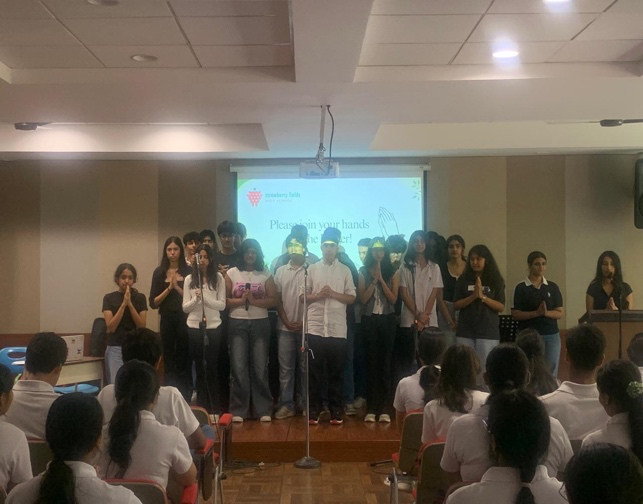
The students of Class 9B, The Helix Group, presented a thought-provoking assembly exploring the role
of Artificial Intelligence in human life. The programme opened with references to real-world
developments, including European regulations requiring AI disclosure and restrictions in some U.S. states
on AI making student-related decisions. This set the stage for the central question: What happens when
machines are given the power to judge humans?
The concept unfolded through a talent show judged by AI systems, highlighting the contrast between
mechanical scoring and human interpretation. A dance performance received precise, data-driven
verdicts, prompting the audience to reflect on whether creativity and artistic expression can truly be
measured by numbers.
A student debate explored whether AI simplifies life or encourages people to outsource their thinking.
Concerns surrounding bias, overreliance on technology, and the loss of human context were raised. The
AI judges’ criticism of the debate for lacking sufficient data further emphasised the limitations of machine
logic when compared to human reasoning.
Audience interaction revealed how readily people can place their trust in technology, at times even more
than in friends and family. A satirical news segment presented AI-related developments and society’s
increasing dependence on chatbots for homework assistance and emotional support, reminding the
audience that these issues are already becoming part of everyday life.
The assembly concluded with a musical performance that was dismissed by the AI judges as
“inefficient.” This sparked a powerful final question: What exactly are you judging? The moment reinforced
the idea that effort, emotions, determination, and human experiences cannot be reduced to numerical
scores. The programme ended with a reminder that while AI is a valuable tool, it can never replace
genuine human connection, empathy, and understanding.
Key Takeaways
• AI in education is actively influencing policies, teaching, and learning.
• Human judgement values effort, empathy, creativity, and context beyond data.
• Mental well-being requires authentic human relationships rather than instant machine
responses.
• Student voices are essential in shaping how technology is used in schools and society.
Student Reflections
Sehar Kapoor- 9B
“As students, we constantly look forward to this time of the year. It is a time filled with ideas, teamwork,
and unexpected challenges that we work through together to reach common ground. This year’s theme,
‘AI is Taking Over the World,’ allowed us to explore different viewpoints, its consequences, and even
its benefits. Through the experience, we developed a deeper understanding of AI and its growing role,
particularly in education.
As a narrator and scriptwriter, I improved my speaking, writing, and collaborative skills. Most importantly,
I enjoyed working closely with my classmates, exchanging ideas, and creating memorable moments
together. It was a refreshing break from our usual school routine and an experience I will always cherish.”
Anusha Malhotra- 9B
“Being the narrator of Class 9B’s assembly alongside Shanaya Nain was truly a wonderful experience.
Despite having only a week to prepare, our class worked diligently to deliver a memorable presentation.
Our theme,’ AI Taking Over the World,’ enabled us to combine humour, audience interaction, and
creative performances into one engaging programme.
Throughout the preparation process, we grew closer as a class and learned the importance of teamwork.
Although there were occasional disagreements, we learned to compromise, communicate effectively, and
respect different perspectives. Overall, the experience taught us valuable lessons that extended far
beyond the classroom.”